Jiu Jitsu for Law Enforcement in Chicago
Physical encounters in law enforcement are unpredictable, fast, and often end up on the ground. Brazilian Jiu Jitsu is built for exactly that: leverage, control, and composure under pressure. Southside Jiu Jitsu Club in Woodlawn offers law enforcement officers on Chicago's Southside access to serious, ongoing BJJ instruction under a Gracie-lineage black belt with more than 15 years of experience.
Why Consistent BJJ Training Matters for Officers
The gap between academy training and real encounters
The problem with defensive tactics training in most departments is not the content. It is the frequency. A well-designed certification course teaches useful skills. But skills practiced once or twice a year do not hold up under the stress of an actual encounter.
Research has documented this for years, and officers who train BJJ regularly tend to recognize it quickly from personal experience.
Consistent BJJ training works differently. Showing up weekly, drilling techniques, and rolling live against a resisting partner builds something a two-day certification block cannot: composure. Officers who train regularly learn to function when their heart rate is high, when the situation is uncertain, and when the outcome is not guaranteed. That is the environment they are in every time they step on the mat.
Experienced defensive tactics instructors have pointed out the difference between the "train a lot a little" model (frequent, shorter sessions) and the more common "train a little a lot" approach of sporadic high-volume blocks. The former produces durable skill. The latter produces skill that fades.
Control and force options: what BJJ adds
BJJ is built around leverage, positioning, and control. The goal is to manage a situation without striking: to get into a position of dominance, maintain it, and bring an encounter to a safe resolution. That approach fits naturally within the constraints of law enforcement work.
An officer trained in BJJ has more options than one who is not. They can control a non-compliant subject without defaulting to a higher force option. They can manage a situation on the ground, which is where many physical encounters end up regardless of how they start. And they can do this effectively regardless of size difference, because BJJ is built on technique and leverage rather than physical attributes.
For more on how BJJ functions as a real-world self-defense system, see our article on jiu jitsu for self defense.
Benefits of BJJ for Police & Law Enforcement Officers
Physical control and restraint skills
Takedowns, positional control, joint locks, and control holds map directly onto what law enforcement officers need in the field. The emphasis is always on controlling a subject through positioning rather than through strength or striking.
This matters for two reasons. First, it reduces injury risk on both sides of an encounter. Officers who know how to take someone to the ground safely, establish a controlling position, and apply restraint techniques are less likely to cause unintended harm and less likely to be injured themselves. Second, these skills work across the full use-of-force spectrum. An officer with strong BJJ fundamentals has options at every level of escalation, which makes decision-making in the field more deliberate and less reactive.
Stress inoculation and composure under pressure
Live rolling, sparring against a resisting training partner, is one of the most effective stress inoculation tools available. It is not choreographed. The outcome is not predetermined. An LE officer who spends time on the mat learns to think clearly when the situation is physically demanding and the stakes feel high.
A
survey conducted by researchers from Northern Illinois University showed that more than 300 law enforcement officers found positive correlations between BJJ training experience and self-reported confidence in use-of-force situations. Officers also reported improved stress levels and fitness since beginning BJJ training. These findings align with what coaches and officers describe from experience: time on the mat makes high-pressure situations feel more manageable.
De-escalation as a byproduct of confidence
One of the less-discussed benefits of BJJ for law enforcement is how it changes an officer's read of a situation. An officer who understands what a trained person can do, and who has been in countless uncomfortable physical situations on the mat, may approach a confrontation differently than one who has not. The confidence that comes from real physical competence tends to reduce reactive decision-making.
When officers resolve a situation with control and minimal force, the downstream effects extend beyond the immediate encounter. Communities notice how officers handle difficult situations. Consistent, measured responses build the kind of trust that affects how residents interact with law enforcement over time.
Fitness and longevity
BJJ is demanding, full-body conditioning. Police officers who train regularly maintain the kind of physical capability the job requires not just in year one, but across a career. The combination of cardiovascular output, strength, flexibility, and body awareness that BJJ develops is difficult to replicate in a standard gym routine.
Law enforcement is a physically demanding profession with a long timeline. Consistent BJJ training is an investment in staying capable throughout it.
If you are a police officer looking to build real defensive skills through consistent training, the first step is a free goal-setting consultation at SJJC. It is a conversation about your background, your training goals, and where you want to go. No sales pitch, no pressure.
Schedule your free consultation →
Why Train at Southside Jiu Jitsu Club
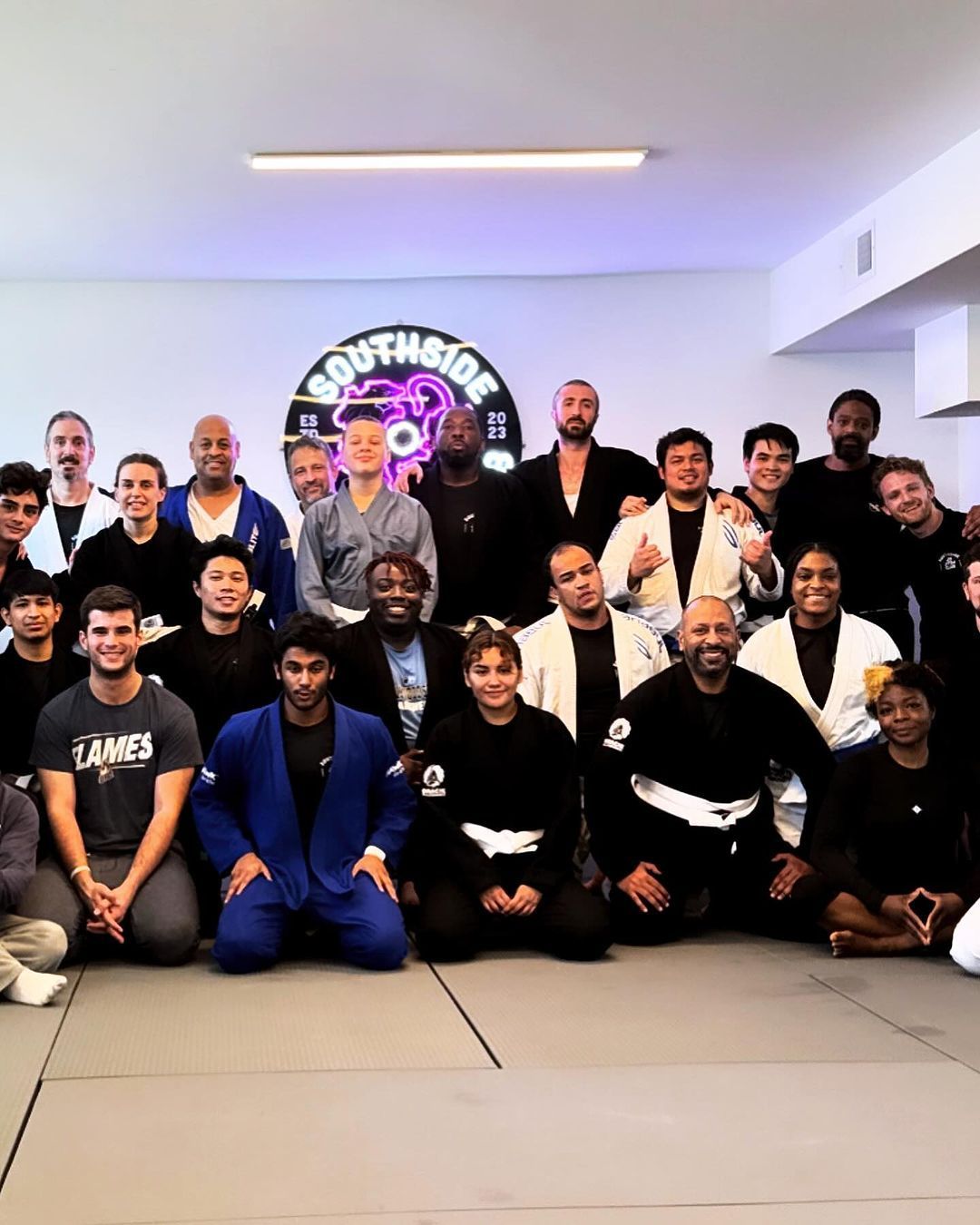
Southside Jiu Jitsu Club is led by Solomon "Solo" Dixon, a 1st Degree Black Belt under Adem Redzovic, who is a 4th degree black belt under the Gracie lineage. That lineage is direct and verifiable. SJJC is an independent academy in Chicago, not a franchise, not a fitness gym with a BJJ program attached.
Solo has over a decade and a half of martial arts experience and has built the club around a clear mission: using BJJ as a tool for community empowerment on Chicago's Southside. For law enforcement officers working these neighborhoods, that context matters.
Learn more about Solo and the coaching staff →
The class schedule accommodates shift work. Early morning classes run Monday and Thursday from 6:00 AM to 8:00 AM. Evening classes are available Monday through Friday, with weekend morning classes Saturday and Sunday. All Levels BJJ, Advanced BJJ, and Randori are all on the schedule, covering everything from foundational ground work to competitive-level rolling and open mat.
View the full class schedule →
How to Get Started
The first step is a free goal-setting consultation. It is a conversation about your background, your training goals, and where you want to go. From there, the 6 Week Transformation Challenge is the structured on-ramp into membership, covering a minimum of 18 classes over six weeks alongside nutritional coaching and accountability check-ins. Members graduate into the Prime Membership with full access to the class schedule.
Frequently Asked Questions
Is BJJ useful for law enforcement if I have no martial arts experience?
Yes. BJJ is built on technique and leverage, not on prior athletic ability or size. The 6 Week Transformation Challenge is specifically designed to bring new students into the program with no assumed background. Officers without martial arts experience start on the same path as everyone else and develop real skills through consistent training.
How is training at SJJC different from a department defensive tactics course?
Department defensive tactics courses cover a broad range of skills in a limited time. They serve a certification function and establish a baseline. BJJ training at SJJC is ongoing, technique-specific, and practiced against live resistance. The two approaches are not in conflict. Consistent BJJ training complements and reinforces what departments teach, and builds on it over time.
What classes are best for police officers just starting BJJ?
The 6 Week Transformation Challenge is the right entry point regardless of experience level. It provides structured instruction and builds a foundation before moving into the regular class schedule. Officers with prior experience can discuss class placement during the free consultation.
How often should I train to see real improvement?
Two to three sessions per week produces meaningful, compounding improvement over time. More is better when recovery allows for it. The SJJC schedule, with early morning, evening, and weekend options, makes it realistic to hit that frequency even around shift work.
Does SJJC offer group training for departments or agencies?
Reach out directly at (312) 554-9038 or info@southsidejiujitsuclubchicago.com to discuss what is possible for group or departmental training.
Can I drop in to try a class before committing?
The free goal-setting consultation is the best first step if you're not already an active BJJ practitioner. It puts you in front of the coaching staff, answers your questions, and sets up the right starting point rather than dropping into a class cold. If you already practice BJJ regularly and want to drop in when visiting, please reach out.
Previous Blogs