Can You Hit or Kick in Jiu Jitsu?
The short answer is no. You can not "strike" (punch, hit, kick, etc.) in BJJ.
Brazilian Jiu-Jitsu does not involve punching, kicking, or striking of any kind in standard training or competition. If you've been watching UFC highlights and wondering whether BJJ classes mean getting punched in the face, they don't.
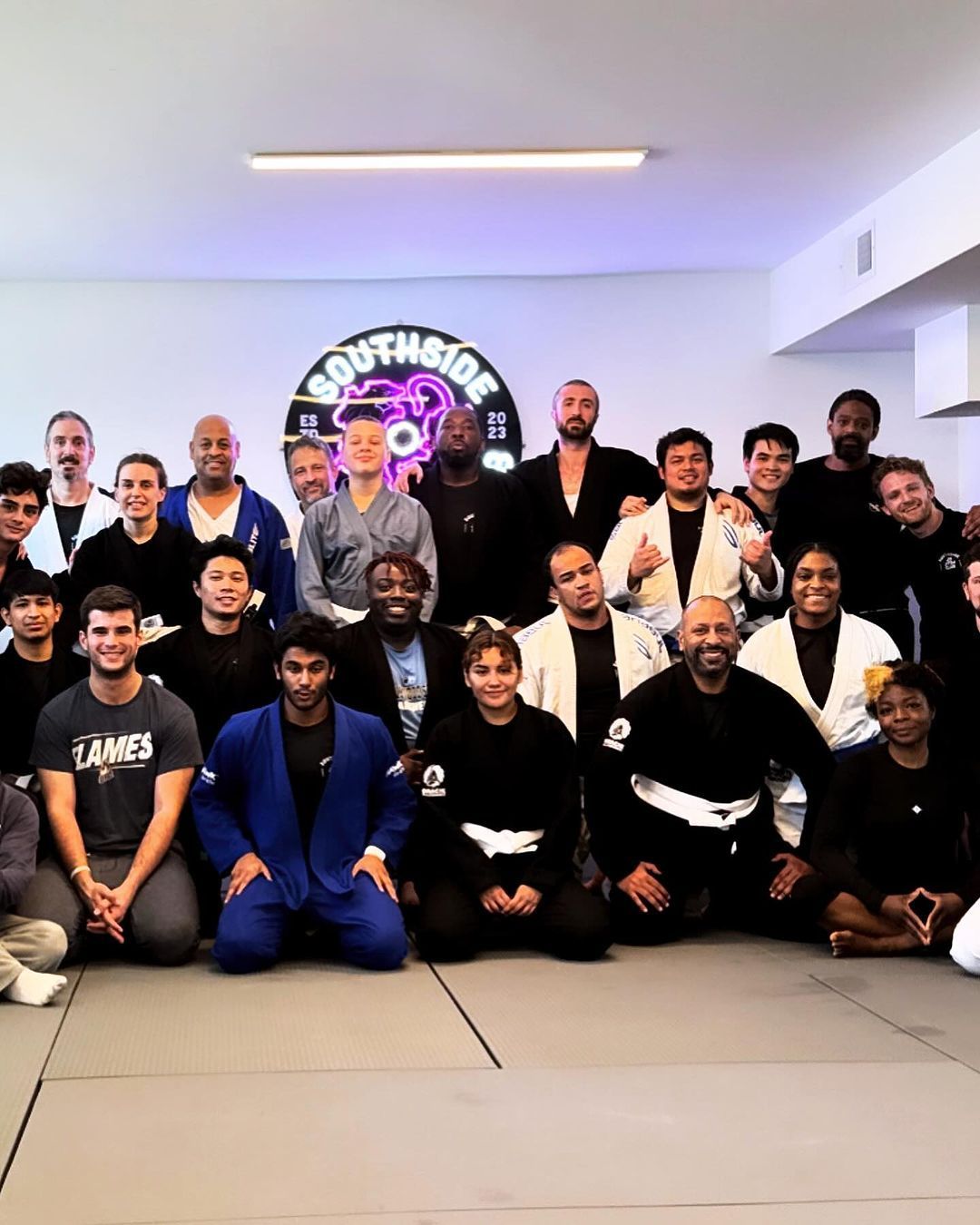
That said, context matters. The full answer looks a little different depending on whether you're talking about sport BJJ, self-defense training, or mixed martial arts (MMA). If you're considering getting on the mat here on Chicago's Southside, this piece will give you a clear picture of what BJJ actually is before you show up.
BJJ Is a Grappling Art
No Striking in Training or Competition
Brazilian Jiu-Jitsu is built around two things: submissions and positional control. A submission is any technique that forces your opponent to tap out, whether that's a choke or a joint lock applying pressure to a limb. Positional control means establishing a dominant position on the ground, such as mount, back control, or side control, where your opponent has limited options and you have the leverage advantage.
Punches, kicks, elbows, and knees have no role in that equation. Not in drilling. Not in live rolling. Not in competition. This holds at white belt and it holds at black belt.
This is not a gap in the art. It is a deliberate design choice rooted in the philosophy Helio Gracie refined over decades. The idea is that a smaller, less athletic person should be able to control and submit a larger, stronger opponent through technique and leverage alone. Striking reintroduces the size and strength advantage that grappling is specifically built to remove.
For a higher level overview of BJJ, check out our article: What is Brazilian Jiu Jitsu? →
Jiu Jitsu Official Rules
In BJJ Competition
At every major BJJ tournament, striking is an automatic disqualification. The International Brazilian Jiu-Jitsu Federation (IBJJF) governs most sanctioned competitions worldwide, alongside organizations like NAGA and local tournament circuits. Across all of them, the rule is the same: no striking of any kind.
Win conditions in BJJ competition are straightforward. You either submit your opponent (they tap out physically or verbally) or you accumulate more points by the time the match ends. Points come from specific positional achievements: guard passes, sweeps, taking the mount, securing back control. No part of the scoring system involves striking, and no striking experience gives you a meaningful competitive advantage.
In BJJ Training and Sparring
The same standard applies during live sparring at the gym. Rolling in BJJ happens at near-full resistance. You are genuinely trying to submit your partner and they are genuinely trying to submit you. Nobody is pulling punches because nobody is throwing them.
What makes that level of intensity sustainable is the tap-out. The moment a technique becomes too much, you tap and it stops immediately. That agreement is what allows practitioners to train hard every session without the cumulative physical wear of a striking art. It is also a big part of why BJJ develops real, functional skills faster than many other martial arts: your techniques get tested against genuine resistance, not a cooperating partner.
Self-Defense BJJ and Striking Awareness
When Striking Does Come Into the Picture
Standard BJJ competition and training does not include striking. Self-defense training tells a slightly different story.
Some BJJ self-defense lessons do address striking in a limited way. Short strikes, a palm heel to create distance, a push to disrupt balance before a takedown, are tools for accessing dominant grappling positions. The purpose is not to win a punching exchange. It is to close distance, disrupt your attacker's base, and transition to the ground where your training takes over.
The goal of self-defense BJJ is control and neutralization, not escalation. Getting to a dominant position and holding it until the situation is resolved is the objective, not landing the hardest hit.
In the BJJ community there is an understanding and respect for the art. In a real-world self defense situation, those rules don't necessarily apply - but the techniques absolutely can.
Why Grappling Is Often More Practical
Most physical altercations move to close range quickly or end up on the ground. Grappling gives you functional tools in both scenarios in ways that striking alone does not.
On the ground, size and strength matter far less. A trained grappler can control an untrained person much larger than themselves by managing position and using leverage. Someone who only knows how to strike has very few tools once the range closes or the fight goes to the floor.
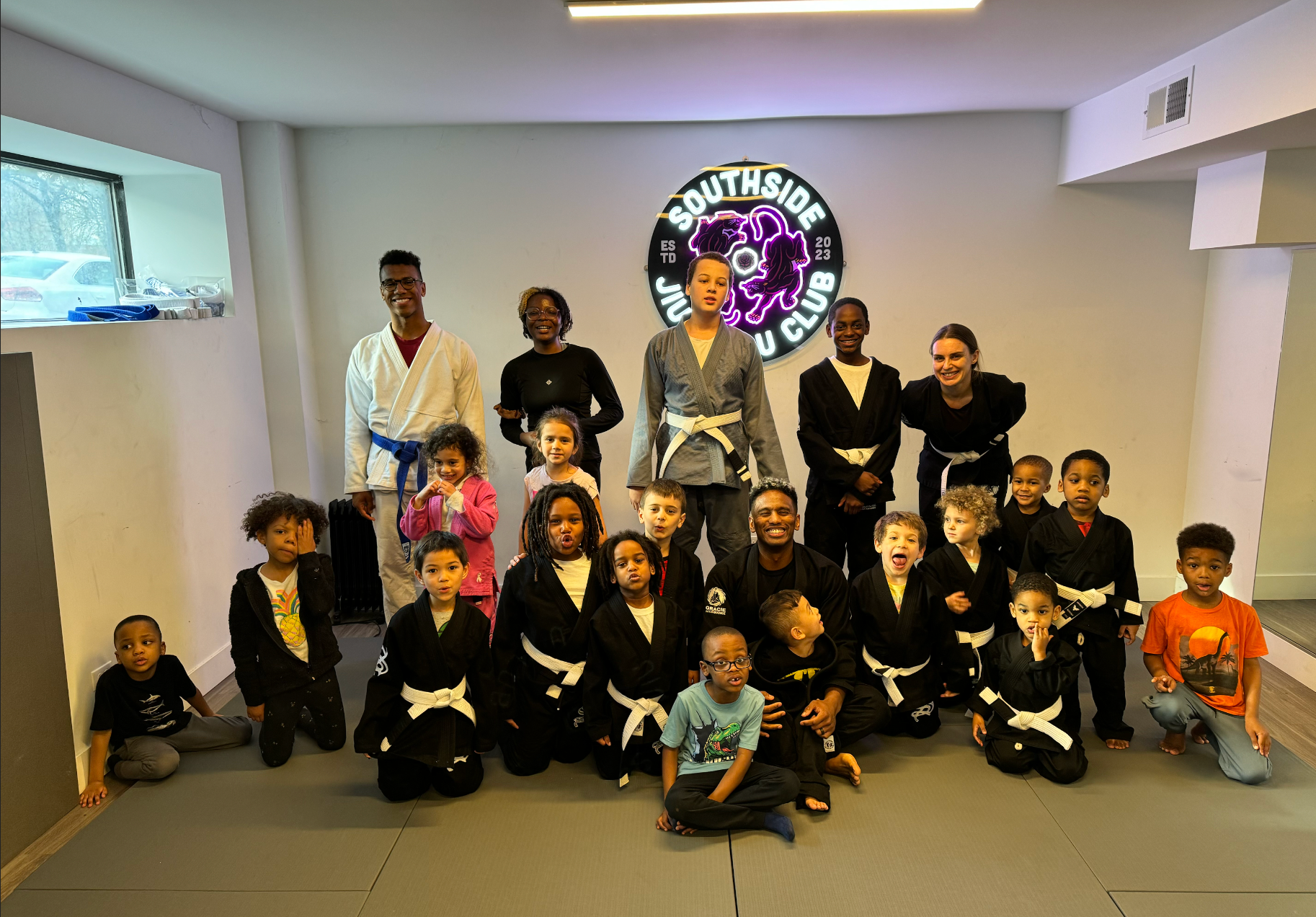
There is also a practical dimension to consider. Being able to restrain and control an attacker without striking them is often the more responsible and defensible outcome. BJJ gives you that option. That approach is central to how training is structured at Southside Jiu Jitsu Club, where the goal is to develop capable, confident practitioners for real life, not only for the competition circuit.
MMA and Combat Jiu-Jitsu
MMA: Where BJJ and Striking Come Together
If you've watched MMA, you've seen BJJ used in a context that includes striking. But it's worth being precise. MMA athletes use BJJ as their ground game. Their striking comes from separate disciplines: boxing, Muay Thai, kickboxing. Those are trained in separate classes and integrated over time into a complete fighting system.
A BJJ class at an MMA gym still follows standard BJJ rules. The grappling and the striking are different courses with different coaches. Walking into a BJJ class expecting an MMA session is like walking into a boxing class expecting wrestling.
Combat Jiu-Jitsu
One exception worth knowing is Combat Jiu-Jitsu (CJJ), a competitive format developed by Eddie Bravo. In CJJ, open-palm slap strikes are permitted once a competitor is grounded. It was designed to address the argument that sport BJJ doesn't account for striking in real-world situations.
CJJ has its own tournaments, rulebook, and competitive community. It is not what you'll encounter when you walk into a BJJ gym for the first time. But if you've seen it online and assumed it was standard BJJ, it is its own separate format.
What This Means For BJJ Beginners
The no-striking rule is one of the things that makes BJJ trainable at real intensity, consistently, over a long period of time.
In a striking art, full-contact sparring carries meaningful physical risk. You have to calibrate contact, wear protective equipment, and accept that your partner might catch you even when they're trying not to. In BJJ, you can roll at genuine effort because the tap is always available. The result is that you get to pressure-test your technique against a fully resisting partner from early on in your training.
Classes involve technique instruction, drilling positions and sequences, and live rolling. Nobody is going to punch you. Nobody is going to kick you. What they will do is work to submit you, and your job is to work to submit them.
Most new members begin with the 6 Week Transformation Challenge: a structured six-week program covering a minimum of 18 classes, with nutritional coaching, accountability check-ins, and a personal goal-setting consultation built in. By the end you won't just understand how BJJ works in theory. You will have felt it.
6 Week Transformation Challenge →
Once you complete the challenge, you'll then be able to move into our prime membership with classes including:
And eventually you'll be able to move into
Advanced BJJ classes.
We also have specific classes available for
women's only BJJ.
If you want to talk through what training looks like or whether BJJ is the right fit for where you are right now, start with a free goal-setting consultation with head instructor Solo Dixon. It's a no-pressure conversation, and it's where every new member at SJJC begins.
Frequently Asked Questions
Can You Punch in Jiu Jitsu?
No. Punching is not permitted in BJJ training or competition. Throwing a punch in a match results in immediate disqualification. The same standard applies during live sparring at the gym.
Can You Kick Someone in a BJJ Match?
No. Kicking is not allowed under any major BJJ ruleset, including IBJJF and NAGA. BJJ competition is built entirely around submissions and positional scoring.
What Happens If You Throw a Punch During a BJJ Match?
It is an immediate disqualification. There is no warning and no penalty point system for striking. The match ends.
Is BJJ Still Effective for Self-Defense Without Striking?
Yes. Most altercations close into grappling range or end up on the ground, which is exactly where BJJ training applies. Self-defense BJJ also incorporates basic striking awareness as a tool for closing distance and transitioning to dominant positions, not as the primary strategy.
Does BJJ Teach You to Defend Against Punches and Kicks?
Yes. BJJ self-defense training covers how to manage distance, close the gap on a striker, and bring the fight to the ground where grappling training takes over. The goal is to remove the range that makes striking effective in the first place.
Previous Blogs